Okay, spring leaves beer on the mind. I am preparing for the worldwide premier of THE HOPOPOTAMUS® and yet I have not finalized the recipe, especially the hops. I am pretty sure that Crystal, Cascade and Amarillo will make the cut, but I figure why not let my dear readers chime in? Besides I am an economist and should not be trusted to brew a beer as anticipated as THE HOPOPOTAMUS®. So I have created a poll to tap into the wisdom of crowds.
So, lend me your expertise and take the poll (over at The Oregon Economics Blog)! I probably won't make it to Steinbart's until the weekend after next, so you have a little time to ponder.
Tuesday, April 13, 2010


Brewing it Yourself and Growing Your Own
Over a year ago I mused about whether brewing your own beer was a cost saving strategy and concluded that at the scale of a part-time homebrewer the answer was no. A big part of the cost of ingredients (inputs in econospeak) was the cost of hops (which were particularly high at the time). But hops are practically a weed man, thought I, what if I grow my own? So I did, or am about to, to be precise. For $4.50 I bought a rhizome, a scrounged about for some unused pieces of wood to build a makeshift support for the vine and voila - hops!! I hope.
 What to grow caused me to ponder - but not for too long. I really wanted to grow two varieties (and in fact bought two rhizomes) but the wife convinced me that given our wee garden and my inexperience with gigantic hop vines, I had better just start with one. I chose Cascade - I mean was there really a choice: high yielding, wonderfully versatile with a lovely citrusy-floral bouquet? No. Willamette was the other rhizome I bought (anyone want it?), I thought it would be a good complement but alas, next summer.
Finding space was a challenge and of course a good economist thinks about opportunity cost, so... out went the sage! Opportunity cost of just about zero, right? Apparently my wife was not so sure, but what's done is done and I am sure she will stop being mad at me once she tastes the beer that will result - and between now and then is only 6 or 7 months...

Nevertheless, your intrepid beeronomist jury-rigged a hop support and prayed that he would still have a fence come winter. Besides, I kept them out of the veggie beds which my wife controls (and hasn't gotten around to weeding yet) so I am on pretty firm ground here. If only she were a beer lover...
So at about $2 an ounce, Cascade hops at Steinbarts are not cheap. I think I can get at least a pound (though I have been told not to expect too much the first season). But for a beer with a 8oz hop bill we are talking $16 saved...wow! Okay, best we not think in terms of pure monetary reward. The real reward comes in being a yeoman farmer (that is a way inside economics joke, by the way, for you macro-types - here's to you Bruce!) close to the earth and self-sufficient.
Unfortunately (or happily) it is now time to brew again and to gear up for the spring unveiling of my ultra special Hopopotamus® will require no less than three varieties of hop (and maybe even four) - so off to Steinbarts I shall go. But I shall dream of Emerson's Special Wet Hop Ale come the early fall.

Finding space was a challenge and of course a good economist thinks about opportunity cost, so... out went the sage! Opportunity cost of just about zero, right? Apparently my wife was not so sure, but what's done is done and I am sure she will stop being mad at me once she tastes the beer that will result - and between now and then is only 6 or 7 months...

Nevertheless, your intrepid beeronomist jury-rigged a hop support and prayed that he would still have a fence come winter. Besides, I kept them out of the veggie beds which my wife controls (and hasn't gotten around to weeding yet) so I am on pretty firm ground here. If only she were a beer lover...
So at about $2 an ounce, Cascade hops at Steinbarts are not cheap. I think I can get at least a pound (though I have been told not to expect too much the first season). But for a beer with a 8oz hop bill we are talking $16 saved...wow! Okay, best we not think in terms of pure monetary reward. The real reward comes in being a yeoman farmer (that is a way inside economics joke, by the way, for you macro-types - here's to you Bruce!) close to the earth and self-sufficient.
Unfortunately (or happily) it is now time to brew again and to gear up for the spring unveiling of my ultra special Hopopotamus® will require no less than three varieties of hop (and maybe even four) - so off to Steinbarts I shall go. But I shall dream of Emerson's Special Wet Hop Ale come the early fall.
Friday, April 9, 2010
Upright Brewing Turns One

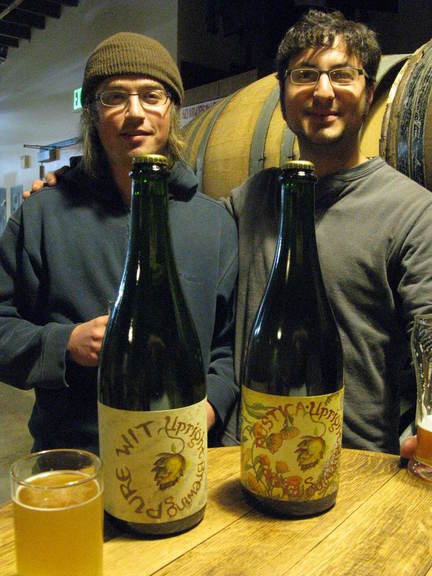
The Four Play is the star however: a truly delightful infusion of cherries into the already wonderful Four produces a dry yet complex belgian ale with a subtle cherry flavor that is ever-present but not too assertive. Again the house yeast is, I imagine, largely responsible for counteracting the sweetness in the fruit. This is a special beer worth a special trip. It was dark in the brewery when I tried it but it appeared to have a rose tinted glow to it and I look forward to a glass bathed in sun.
The festivities start at 4:30 and continue on until 9. The LeftBank Project is at 240 N Broadway at the east end of the Broadway Bridge.

Cheers.
Tuesday, April 6, 2010
Foyston on Ninkasi

Benjamin Brink/The Oregonian
Just a note to guide you to John Foyston's piece in today's Oregonian on Ninkasi. Some highlights:
Last year, Ninkasi brewed 18,000 barrels of beer (558,000 gallons) and graduated from microbrewery -- making up to 15,000 barrels a year, as defined by the Brewers Association, a national trade group -- to regional brewery, joining the likes of Rogue Ales, Full Sail, Widmer, BridgePort and Deschutes.
...
This year, Floyd said, Ninkasi is on track to nearly double last year's total and brew as much as 32,000 barrels -- nearly a million gallons of beer.
That kind of growth can spell trouble, said Paul Gatza of the Colorado-based Brewers Association; he's seen it happen before.
"They really seem to be doing something right," he said, "but plant capacity becomes a real holdback to that kind of growth rate -- it's very unusual for a brewery to be able to sustain a growth of more than about 10,000 barrels a year."
But, thanks to the left-brain/right-brain partnership between Floyd -- the creative, charismatic brewery frontman -- and Ridge -- the financial and planning wizard who spent his college summers interning on the floor of the New York Stock Exchange -- Ninkasi is ready.
...
Butenschoen said that Floyd also saw a wide-open market in Eugene for a production brewery and that the outcome would've been very different had they started a brewpub.
"If you're a brewpub, you're often seen as competition by other pubs and restaurants, and they're not likely to put your beers on tap."
A few thoughts: First, I was fascinated by Ninkasi's business model from the start. The standard modus operandi of new Oregon craft brewers these days is to start a brewpub. The state makes it easy with a special license from OLCC and the food side helps on the revenue front. But restaurants are hellishly difficult beasts to do well and concentrating so much on the restaurant can inhibit your ability to get the beer out of the door. Ninkasi started by doing its own distribution of its kegs to restaurants and bars and thus was able to capture all of the revenue themselves to start (and maybe offer it more cheaply?) - and were able to get an astonishing number of taps quickly (fantastic beer helps a lot too...). Anyway, it is interesting what they say about the perceived competition of brewpubs versus breweries.
Second, Ninkasi from the start mastered the art of the new social media: Facebook pages, Twitter feeds, etc. These days, among the youngsters at least, this is a low cost and very effective way to get yourself known. Ninkasi has been more active on this front than any other brewery I am aware of.
Third, they are apparently ready to start packaging in 12oz six-packs. For this I say hooray. Big beers in big bottles are difficult for a wee economist whose wife is not really a beer drinker.
Friday, April 2, 2010
A Night at Upright

Since my readers are mostly not regulars in the beer-o-sphere I suspect, a little background on Upright is in order. Perhaps the best introduction from the early days is Jeff's. It is located in the basement of the Leftbank project and focuses on Belgian-inspired farmhouse ales. Upright's owner and brewer Alex Ganum is a Belgian beer enthusiast, but it was my impression that he was more a fan of the Belgian brewing ethos than the specific style (as much as there is one - see: ethos). He brews beers in the Belgian tradition but is inspired by local ingredients and uses mostly Willamette Valley grains and hops. He also uses the tricky open fermentation method and his house yeast is a curious beast - but I am getting ahead of myself. For a while Upright's beers were only to be found on tap, but now they are turning up in such places as New Seasons in the bottle. The standard line up includes the delightful Four, the more robust Five and the darker Six.

Brewing such an open style can be a tricky business proposition. Using open fermenters adds some risk to the whole endeavor (though Alex doesn't apparently think it ads much) and building and maintaing a climate controlled and sterile room is expensive. So in a business sense, Alex is banking on people appreciating his efforts, being able to tell when tasting the beer and being willing to pay a small premium for it. It is thus unlikely that many other places in the US would support such efforts (though I may be selling other beer communities short). Alex also uses a yeast that is amazingly hungry but remarkably slow. It takes weeks for the yeast to go through the primary fermentation stage, and then it just keeps on going during secondary fermentation and in the bottle or keg (so when it goes out the door, he is not entirely sure what it will be like upon opening/taping). Keeping the beer around for weeks upon weeks is costly and not being able to completely control precisely the finished product is a risk that most business people like to avoid. I am tempted to make the comparison to wine production, but the dirty little secret there is how much wineries can manipulate the final product with additives. Not so here. This just shows you how different this type of truly craft brewing differs from industrial brewing where the bottom line rules and the product is never, ever supposed to taste any different. Alex admits that it tests his devotion to his yeast, but he hasn't lost faith yet.

The other interesting thing about Alex's yeast is how efficient it is in the end: it eats just about all of the available sugar. Most yeast in the beers we regularly enjoy will achieve 70-75% attenuation, but the good Brothers Widmer analyzed the yeast in the lab (and did so pro-bono - cheers Widmers!) and found that Alex's was achieving up to 97% attenuation. Wow. Jeff has a nice post on the implications of the yeast in the brewing process.
 I had a chance to ask Alex the question that I find most interesting: how do you decide on price? I like this question because for a standard business the textbook answer is clear: you charge the price that maximizes profit. But in this business - with experience goods and where price is a signal of quality - you want to be careful about what price says about your product. Alex talked about the 'right' price and I don't know what was in his head but this was my interpretation. For example, you might think a new brewery would think about pricing very cheaply to get people to try the product so that they could learn about the quality, but doing so might leave the impression that it is not a quality beer (otherwise how could it be so cheap?).
 I'll post on the beer later, but for now, it is definitely worth your while seeking out the beer - perhaps the good folks at Taplister (one of whom, Kerry, I met that night) can help you out. I have seen bottles in New Seasons and I have a suspicion that Belmont Station and the Beermongers might also have a bottle or two in stock. They are also now at the Portland Farmers Market so you can find yourself some tomorrow while you are there. You will not be disappointed. Cheers.
Beer-no-nomics

Deschutes has jumped on the Cascadian Dark Ale bandwagon with Hop in the Dark (pictured). The label was designed by the brother of a friend of mine and is, by association, fantastic. Seriously, it is cool. I am not a huge fan of the CDA or Dark IPA style - I personally find the roasty notes and the floral hop notes in conflict and they don't sing on my tongue as much as argue - but I'll try Deschutes' version as if someone is going to get it just right, more often than not it'll be the Deschutes folks.
Speaking of cool labels, you have to check out Ezra's label for Upright's forthcoming Four Play. You'll get a chance for a first look at the release party on April 9th (more on that tomorrow).


As today is probably the only nice day we will have had or will have in quite a few, perhaps it is a good opportunity to taste some spring beers after work...
Monday, March 15, 2010
The Novelty Curve, Economies of Scale and the State of Craft Brewing
Whew, how's that for a title?
Over at Beervana, Jeff Alworth has blogged a couple of times recently about some new data purporting to show the health and growth of the craft brewing industry. He discusses how the data reveal an interesting fact about the industry: there are a few big players (Boston Brewing, New Belgium, Sierra Nevada, Full Sail, Deschutes) and a TON of very, very small breweries. He and I have also had conversations about the overall trend. Craft beer cheerleaders look at the remarkable growth in market share over the last decade and the still small share in general to suggest that the future is bright and that there is no reason we should not expect craft beer to continue to grow both in overall volume and in the number of breweries. I am skeptical.
The model I have in my head of the craft beer industry in the US is one that is mainly characterized by a tension between two forces: novelty and scale.
The first comes from the natural desire of consumers to consume variety. Most of us don't eat the same meal for dinner every night and we tend to get tired of any one meal we eat too often. But the variety desire at the market level can be also arise because of static and different tastes. Finally, tastes can evolve - consumers get used to hoppy beers, for example. So dynamic tastes, where consumers of beer find their tastes evolving and are always looking for new and interesting experiences, can also drive the market demand for variety. All this leads to the advantage new breweries have in brewing new styles reach customers that were previously badly served because no beer was available that matched their preferences well, or to consumers looking for new things, or to consumers looking for more adventurous drinking experiences. Jeff has coined this the 'novelty curve,' and suggests that new breweries have an advantage over established ones because of new, fresh products. [Ninkasi comes to mind] Established breweries, like Bridgeport for example, have a more difficult time trying to keep a standard line-up selling while at the same time satisfying the desire for new tastes.

The second is a natural aspect of many industries - the larger the volume of the firm, the lower the average cost of producing the product. In brewing the size of the brew house, the ability to have your own bottling line, efficiency in distribution, number of taps, brand recognition, and many other aspects make brewing an industry that is subject to significant economies of scale. What this means is that larger breweries can undercut smaller ones, all else equal. [My colleague, Vic Tremblay, has estimated economy of scale effects for the large industrial breweries up to about 23 million barrels, if memory serves]
Because of these two forces and how they interact with the craft brewing industry, I expect that the industry will always be characterized by a lot of volatility. I think that there will be some stable mainstays (the Deschutes and Full Sails of the world) that have the scale advantages and try hard to keep up a line of unique, one-off, specialty beers to feed the novelty curve. And a lot of churn (in economics-speak) among the smaller breweries. I think the brew-pub model is the way to go here as a stable revenue stream from food and an in-house captive audience for the beer can help tame the vagaries of a fickle consumer base.
All that is to say is that I don't think the number of breweries continuing to increase is a sustainable path and I expect another round of shake outs in the market, unless small brewers can establish a successful restaurant operation. And in general, I think we can always expect breweries to come and go regularly. But this is not necessarily a bad thing - the better breweries, those that brew good beer, are well run businesses, market well, etc. will stick around and new start-ups will keep offering new, interesting beer.
This doesn't mean that the overall market share of craft breweries won't continue to increase, but as this increases it may reinforce the economies of scale advantages of bigger craft breweries. That said, mainstays like Boston Brewing have seen sales stagnate, while lots of little breweries have opened, so we may be in a period where the variety motive in the market is ascendant. The good news in all of this is that the market should always be interesting from here on out for this observer - I think craft beer is here to stay.
Note: the picture is of Hangar 24 craft brewery in Redlands, CA, where my brother is a brewer. Check it out if you are in the LA area.
Over at Beervana, Jeff Alworth has blogged a couple of times recently about some new data purporting to show the health and growth of the craft brewing industry. He discusses how the data reveal an interesting fact about the industry: there are a few big players (Boston Brewing, New Belgium, Sierra Nevada, Full Sail, Deschutes) and a TON of very, very small breweries. He and I have also had conversations about the overall trend. Craft beer cheerleaders look at the remarkable growth in market share over the last decade and the still small share in general to suggest that the future is bright and that there is no reason we should not expect craft beer to continue to grow both in overall volume and in the number of breweries. I am skeptical.
The model I have in my head of the craft beer industry in the US is one that is mainly characterized by a tension between two forces: novelty and scale.
The first comes from the natural desire of consumers to consume variety. Most of us don't eat the same meal for dinner every night and we tend to get tired of any one meal we eat too often. But the variety desire at the market level can be also arise because of static and different tastes. Finally, tastes can evolve - consumers get used to hoppy beers, for example. So dynamic tastes, where consumers of beer find their tastes evolving and are always looking for new and interesting experiences, can also drive the market demand for variety. All this leads to the advantage new breweries have in brewing new styles reach customers that were previously badly served because no beer was available that matched their preferences well, or to consumers looking for new things, or to consumers looking for more adventurous drinking experiences. Jeff has coined this the 'novelty curve,' and suggests that new breweries have an advantage over established ones because of new, fresh products. [Ninkasi comes to mind] Established breweries, like Bridgeport for example, have a more difficult time trying to keep a standard line-up selling while at the same time satisfying the desire for new tastes.

The second is a natural aspect of many industries - the larger the volume of the firm, the lower the average cost of producing the product. In brewing the size of the brew house, the ability to have your own bottling line, efficiency in distribution, number of taps, brand recognition, and many other aspects make brewing an industry that is subject to significant economies of scale. What this means is that larger breweries can undercut smaller ones, all else equal. [My colleague, Vic Tremblay, has estimated economy of scale effects for the large industrial breweries up to about 23 million barrels, if memory serves]
Because of these two forces and how they interact with the craft brewing industry, I expect that the industry will always be characterized by a lot of volatility. I think that there will be some stable mainstays (the Deschutes and Full Sails of the world) that have the scale advantages and try hard to keep up a line of unique, one-off, specialty beers to feed the novelty curve. And a lot of churn (in economics-speak) among the smaller breweries. I think the brew-pub model is the way to go here as a stable revenue stream from food and an in-house captive audience for the beer can help tame the vagaries of a fickle consumer base.
All that is to say is that I don't think the number of breweries continuing to increase is a sustainable path and I expect another round of shake outs in the market, unless small brewers can establish a successful restaurant operation. And in general, I think we can always expect breweries to come and go regularly. But this is not necessarily a bad thing - the better breweries, those that brew good beer, are well run businesses, market well, etc. will stick around and new start-ups will keep offering new, interesting beer.
This doesn't mean that the overall market share of craft breweries won't continue to increase, but as this increases it may reinforce the economies of scale advantages of bigger craft breweries. That said, mainstays like Boston Brewing have seen sales stagnate, while lots of little breweries have opened, so we may be in a period where the variety motive in the market is ascendant. The good news in all of this is that the market should always be interesting from here on out for this observer - I think craft beer is here to stay.
Note: the picture is of Hangar 24 craft brewery in Redlands, CA, where my brother is a brewer. Check it out if you are in the LA area.
Subscribe to:
Posts (Atom)