Thursday, April 7, 2011
Here Come the Firkins!
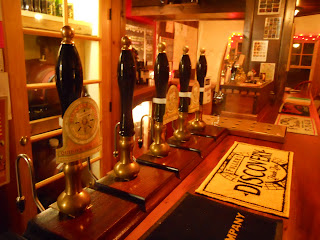
Easily my favorite event of the year, the Green Dragon Firkin Fest, is approaching quickly - Saturday, April 16. [Sorry for the small image, I could not find a bigger one] Why is it my favorite? Three reasons. First, it is all about cask beer, my special interest. Second, it is a small laid back affair. And third, it is at the Greet Dragon, which is a pretty cool place.
This year, I am hoping for more milds, bitters and other traditional English ales that are native to cask. But sometimes the hop bombs are a revelation on cask as well. Last year, Double Mountain's IRA was phenomenal. Ted Sobel from Brewer's Union will be there and I have it on good authority that he is bringing a mild, as he did last year. Other breweries are still trying to figure out the cask thing, but they seem to get better each year (let's hope for no fishy smelling Hopworks!).
Last year the weather was outstanding, warm and sunny, and the patio was the place to be. This year, who knows with this ridiculous weather, but the inside is inviting as well.
It costs $30, but for that you get 8 6oz tasters and two food vouchers which last year could be redeemed for sausage, chocolate or cheese. I did two sausages and loaded them up with kraut and voila: lunch.
Wednesday, April 6, 2011
Oh No!
The new beer sign at the Portland Timbers Jeld-Wen Field. C'mon, in Beervana? Really?
The Widmers will have a beer garden so perhaps this is the AB - Craft Brewers Alliance deal showing itself in the stadium. This sign is in a key location in that that will appear on lots of national TV, so it doesn't necessarily make sense for a local brand. And, even in Beevana, I suspect that 75% of beer sales in the stadium will still be Bud Light.
Monday, April 4, 2011
More on Goose Island
Over the weekend there was an Op-Ed in the Chicago Tribune by John Hall, the CEO of Goose Island explaining the sale.
Apropos of what I said on Friday, here is Hall explaining AB's rationale:
Also in the Trib is an article on the many other craft beer options local to Chicago reinforcing the notion that craft beer is not in peril. The article focuses on Two Brothers and Three Floyds, too bad they chose to ignore the Four Horsemen...
Apropos of what I said on Friday, here is Hall explaining AB's rationale:
But Anheuser-Busch didn't buy us to change us. It bought us because we can do things its people can't. They're megabig, so it's harder to get people who sell huge brands to really push new products. As in a lot of industries, it's the small guys who are really creative, because they have to be creative. That's what's made us what we are.
***
My executive team, including Greg, who's my son and our brewmaster, all agreed that Anheuser-Busch would be far and away the best alternative for us if it would agree to certain conditions. We didn't work 23 years to build what we have just to throw it away.
Goose Island had to remain an independent company, with me in charge, with brewing centered here in Chicago and with sales and marketing reporting up through me. And I would report to just one person in St. Louis.
In other words, we wanted to continue to do what we've done. And they agreed to that right away.
Also in the Trib is an article on the many other craft beer options local to Chicago reinforcing the notion that craft beer is not in peril. The article focuses on Two Brothers and Three Floyds, too bad they chose to ignore the Four Horsemen...
Friday, April 1, 2011
Budweiser buys Goose Island
A few folks have e-mailed me wondering why I haven't posted some comment on the AB-InBev purchase of craft brewery Goose Island. There are a few answers. The most important is that this blog is an offshoot of my main blog, the Oregon Economics Blog, but even that blog is an offshoot of my real job which is as a full-time economics professor at Oregon State University. OSU is on trimesters and my schedule is particularly heavy in the winter and spring quarters, meaning January through June. So it is hard to find time to sit down and write for both blogs as well as keep up with all my other responsibilities. Which is all a mea culpa for posting so infrequently these days. Sorry.
The second is that what interests me is economics not business, so pure business rationale is not necessarily something I am motivated to post on, what I like as an economist is to think about why certain business decisions make sense - what are the economic forces at work behind the scenes as it were.
The third is that, given my interest in the economics, I am still trying to think through all of the angles of this. As a academic I am trained not to shoot from the hip and so my bloggy persona and my professional persona are often in conflict.
So with that needlessly long-winded intro, here are some thoughts on the deal:
- My first thought was something that Rogue owner Jack Joyce said to me and a group of students a few years ago. He was saying that the big brewers could easily best the craft brewers but that the corporate structure lacked patience. Once you are corporate and divisionalized, the marketers want to know how to sell the beer, the bean counters want to know that there will be big sales at the outset to justify the marketing budget and the corporation is worried about the bottom line so why should they go for lower profit-margin beer? Since, getting the public to accept and adapt to a good craft beer takes a lot of patience - you have to be willing to grow a craft beer line slowly and wait for the delayed rewards - this is something the modern brewing behemoths are not used to doing.
- Part of craft brewing's ethos is the idea that it is an artisanal product and the brewers themselves are part of the 'personality' of the beer. It is hard for a generation of craft beer drinkers that have been brought up on this to accept a big brewers brewing quality craft beer. Converting mainstream drinkers to things like Bud's American Ale has not been very successful. So either you create a faux craft brewery ala Blue Moon and grow it slowly (see point #1) or you look to acquire an established brand.
- Economies of scale are the name of the game in brewing, but in craft brewing I think the demand is such that a brewery should accept the economies of scale hit you take from sticking to a smaller brewery, and instead leverage the economies of scale you have in distribution and ingredients. This is not too distant from the Craft Brewer's Alliance deal with AB.
- This is a typical big corp. play in a world of innovative entrepreneurs - think of Microsoft and Google gobbling up the Hotmails and YouTubes. I think it demonstrates three things. One, that the craft beer market is only going to get bigger and bigger. Two, that there is a lot of great new breweries and brewers out there. Three, that the big timers are getting in the market for real this time and they are not going away.
- I don't think this is anything to fear, I think it means that craft brewing is going to grow that much faster. Either AB-InBev leaves Goose Island alone in terms of creative license or it will fail. In this modern era of new and innovative beers, no one company will every be able to create meaningful market power.
So in the end I think this is good for craft brewing and I don't see any reason to stop supporting Goose Island and their beer. In the future it'll either be good or it won't. If it is good, buy it.
An e-mailer asked me about this comment:
It is the lack of AB’s actions to do anything serious in this sector that speaks the greatest volumes. AB has more of everything that anyone has ever needed to move into the craft beer market. They have had the capital, the physical plant, the brewing expertise and the distribution chain to do this on their own for their entire existence, IF they truly wanted a card of genuinely high-quality beer in their product line. There is no company in the world with more opportunity to deliver on whatever intention they have to make great beer. There are but two things that have stopped them: bean counters and shareholders. They demand growth and increased profits. Growth they will get by buying decent breweries. Profit they will get by cheapening their product. That has been the A-B modus operandi for 50 years. The burden of proof to show that they are changing is on you, and not on the justifiably skeptical beer geeks.
To which I would respond with a reference to Jack Joyce's comment from a few years ago. Big corporate brewing doesn't understand how to market and grow a quality craft beer, but they do know how to buy a successful company. It remains to be seen if they will keep hands off, and in that will lie the true judgement. But the market is sophisticated now and I think it'll punish quickly any attempt to use the Goose Island brand to sell American Ale. Hopefully Bud will see this and understand. I don't think it is a forgone conclusion that they will dilute the Goose Island brand.
Tuesday, March 29, 2011
A Tale of Four Businesses. Part 4: Brewer's Union Local 180
Finally, finally, finally I finish my series on the four southern and mid Willamette Valley brewing businesses I visited with Jeff Alworth in, uh, November. So today we venture back to Oakridge to visit Brewer's Union Local 180 and Ted Sobel, the publican and visionary behind what is, to my mind, the most unique brewpub in Oregon and one of the few that are a pure Oregon treasure.
When I first heard of Ted Sobel my impression was a crazy man in the woods with a thing about real ale. Which is basically right - you would have to be crazy to pick out Oakridge, Oregon to launch your business and he does have a thing about cask-conditioned real ale. But he is not crazy in the sense of CAMRA purists and his passion for real ale, I soon discovered, is not out of Nazi purism but of a complete vision of what a rural, local brewing pub is and what such a place means to a community. A vision he developed in time spent at local brewing pubs in Britain and has perfected in Oakridge.
Given my own passion for cask ale, English ales and smaller beers, I eagerly sought out Ted and his beer after hearing about him, finally getting the chance to meet him and his beer last year at the Green Dragon Firkin fest (which, incidentally, is coming up again soon on April 16 and Ted will be there again I understand and of course this make the timing of this post impeccable! - there is reason to my madness after all). At the time my impression was that cask ale was his passion and his hook. But it wasn't until I visited the pub in Oakridge that I understood the beer is only part of a more complete vision of a rural, local pub that is a part and even a centerpiece of a community.
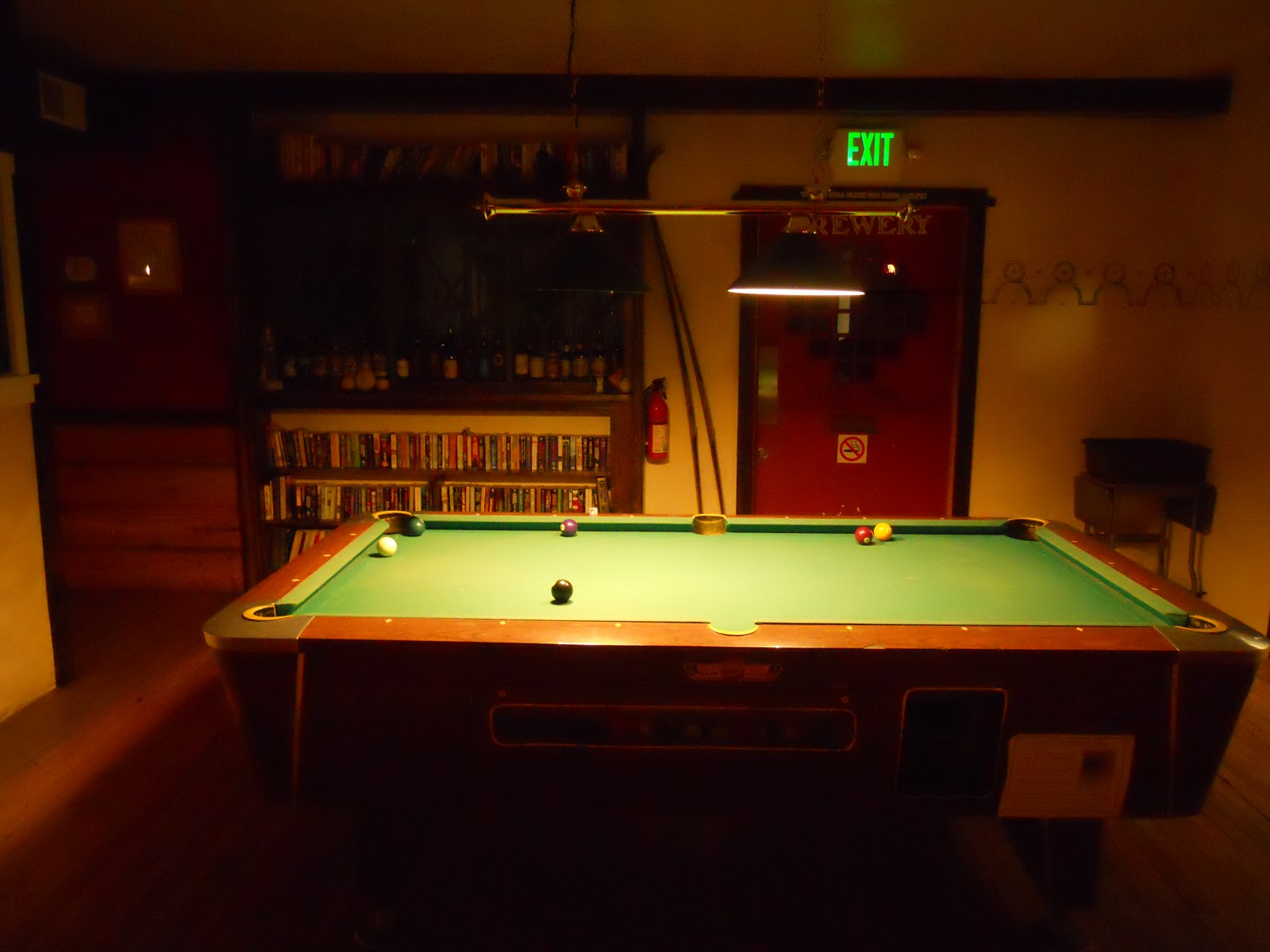
| Pocket billiards |
Ted finally answered a lingering question for me, which was why most beer served on cask in local bars and pubs is considered not quite legit according to the CAMRA-types. The answer is, apparently, that most breweries will take beer from a conditioning tank, put it in a firkin and then add priming sugar, much like the traditional homebrewer does, to re-activate the yeast and produce the desired carbonation. However, traditional cask ale is created by taking beer from the fermentor before it has entirely finished out, condition it, and then warm it back up to reactivate the yeast and create carbonation from the remaining sugars already present. It is an incredibly subtle distinction, but Ted's beer is done the latter - correct - way. Despite being a purist himself, Ted is not critical of those that do it the other way - cognizant, I suppose of the realities of a brewery trying to do everything. His fully realized vision allows him to do it the way he prefers, and that, I believe, is the point.
| Note the floor made of the old MacArthur Court. Yes, the very one played on by the National Campion Tall Firs. Go and take Darshan. |
Ted's business suffers in the lean winter months, but then picks up when the hikers and mountain bikers return to the mountains in the spring and summer months. I was there in the cold and wet fall, and the pub was a cozy and inviting place to settle in for an evening and Ted's beer which is mostly quite small, is very sessionable - so you can settle in for and evening without feeling it the next day. It was quiet but a number of locals wandered in and out. The pub has no TVs so, gasp, there is naught all to do but chat. Of course there are other diversions, stocked bookshelves, a pool table and free WiFi if you prefer the solitary amusements.
As an aficionado of fish and chips it behooves me to mention that Ted's are very, very good: moist and flaky fish in a light and well cooked batter on top of a pile of crisp chips. Excellent. I did not try the other food from the kitchen but it features very traditional British pub food such as bangers and mash as well as more American standards like burgers and reuben sandwiches.
The point that I am trying to make in this whole write-up is that most reviews of brewpubs focus on the beer and then incidentally the food, ambiance and so on. But Brewer's Union is the realization of a complete vision and all aspects - the beer, the space, the food and so on - are critical complements of each other. Jeff and I understood the completeness of the vision when upon checking in to the Oakridge Motel and informing owner Vivian of our plan to spend the evening at Brewer's Union, she said to give her regards to everyone there. This, I think is the point of Ted's vision - a pub that is interwoven in the social fabric of a small town.
And so even the crazy decision to open in Oakridge made sense to me in the end. And as we left Oakridge on a typical November Oregon day - misty, wet and gray - I gazed lazily at the tops of the surrounding Cascade foothills that had gotten a dusting of snow the night before and decided the whole experience, the setting, the town and the pub, was enchanting.
As an aside, Ted and I both have a connection to Ithaca, New York (me school, he hometown, I think). He has a nice bog post about a return home and a trip to Ithaca Beer Company (whose owners are friends of mine and whose birth I witnessed first-hand) and an old haunt: The Chapter House.
Thursday, March 24, 2011
Context and Relativity in Beer Prices
In economics, it turns out, relative measures matter a lot. For example, peoples' satisfaction with their own income depends a lot on the incomes of their neighbors and friends. People place value on things like cars and barbecues that depends not only on their own intrinsic value but on how much better they are from the next best thing. This fact does not easily fit into a lot of economic theory that deals only in individual decision making. You have do get into game theory to start to describe these types of values that depend on others actions - and that gets hard quickly.
Anyway I thought of all this when I finally encountered a Ninkasi six-pack in my local grocery store and was taken aback by the price: $10.99. Holy s#%t, I thought, that is expensive. It is substantially more than say a Bridgeport, Deschutes or Full Sail sixer.
Except that it isn't of course, in fact it represents a substantial discount per ounce then the standard 22oz. Ninkasi bomber bottle that generally retails at $3.99. Bill Night has been pointing this out for a long time, of course, but it is one thing to talk about rationally and quite another to experience it emotionally. Using Bill's Six Pack Equivalent (SPE) calculator it is easy to see that a 22oz bomber at $3.99 translates to a six pack price of $13.06.
So the Ninkasi sixer actually represents a much better deal than the previous 22oz bottle which makes little rational sense as the packaging per dollar has gone up. But of course when you buy a six pack you are buying 72oz total and thus the better price is a volume discount. See previous posts on non-linear pricing to understand why companies can do better but following a non-linear pricing strategy.
But what really matters, at least to the front of my mind where the first emotional responses form is that Ninkasi 22s were generally among the cheapest ones on the shelf and now the Ninkasi sixers are the most expensive. And where I was very happy to fork over $4 for a 22, I am now reluctant to spend $11 on a sixer even though I am the only beer drinker in my household and a 12oz bottle of a big Ninkasi beer is generally all I need. Its all in the framing - the relative comparisons. Before I would look at a bomber of Deschutes Red Chair, say, for $5.49 and quickly choose Ninkasi. But now I look at a sixer of Red Chair for $6.99 and a sixer of Ninkasi for $10.99 and I am not likely to buy the Ninkasi. Except that I will probably buy a bomber - despite my knowledge of Bill's SPE calcs.
I always thought of Ninkasi as very savvy for coming in at an aggressive price point for their bombers and it'll be interesting to see what happens now given that their sixers are going to be relatively expensive.
Because it is all relative.
Subscribe to:
Posts (Atom)